How to Make Edible Cookie Dough: Safe, Creamy & Ready in 10 Minutes
Affiliate Disclosure: As an Amazon Associate, we earn from qualifying purchases at no extra cost to you.
Quick Answer: To make edible cookie dough safely, replace raw eggs with milk and heat-treat all-purpose flour to 165°F (74°C) to eliminate bacteria like E. coli. Cream softened unsalted butter with brown and white sugars, then mix in vanilla, salt, milk, cooled flour, and chocolate chips.
- Prep Time: 10 minutes total
- Key Safety Step: Bake or microwave raw flour to 165°F before mixing
- Leavening Agents: Omit baking soda and baking powder completely
- Shelf Life: Up to 7 days refrigerated or 3 months frozen
Knowing how to make edible cookie dough lets you enjoy rich, nostalgic spoonfuls straight from the bowl without foodborne illness risks. Traditional cookie recipes rely on raw eggs and untreated flour, both of which carry dangerous pathogens when unbaked.
This guide gives you the exact food-safe temperature targets, ingredient ratios, and mixing techniques used by pastry professionals. You will get a smooth, scoopable base ready for chocolate chips, peanut butter, or ice cream mix-ins.
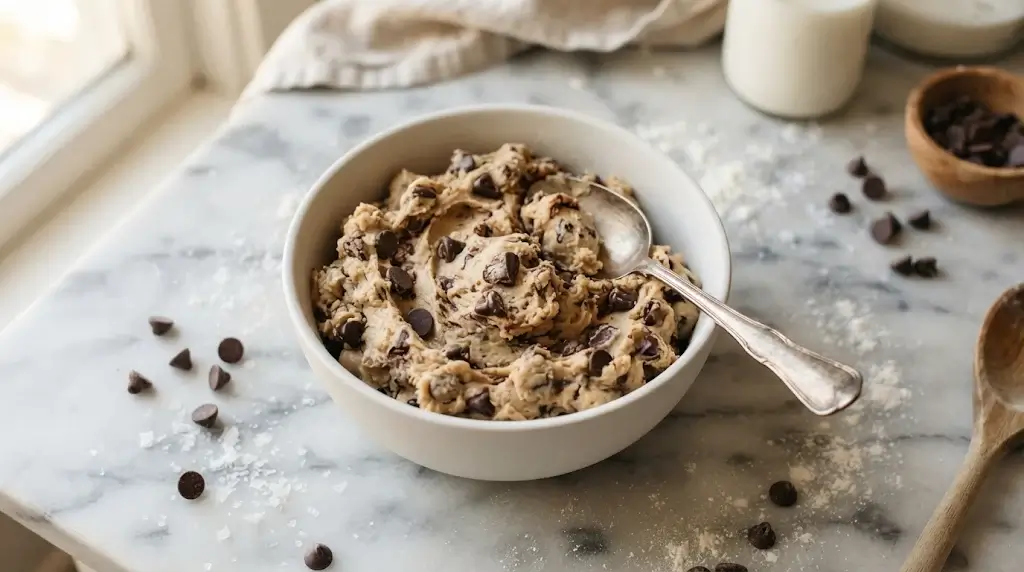
Why Traditional Raw Cookie Dough Is Unsafe to Eat
Most home bakers blame raw eggs for cookie dough illnesses, yet raw flour poses an equal threat. Wheat grows outdoors where grains contact animal waste, and commercial milling does not kill bacteria like Escherichia coli or Salmonella.
A safe no-bake cookie dough requires three structural changes from standard baked cookie recipes:
- Eliminate raw eggs: Swap eggs for dairy milk, heavy cream, or unsweetened almond milk to bind the dough without Salmonella risk.
- Pasteurize the flour: Heat all-purpose flour to an internal temperature of 165°F (74°C) to neutralize pathogens.
- Remove chemical leaveners: Leave out baking soda and baking powder, which taste metallic and soapy when unbaked.
How to Heat-Treat Flour Safely (Oven vs. Microwave)
Heat-treating flour takes under five minutes and prevents chalky, unsafe dough. Always verify the flour reaches 165°F across multiple spots using an instant-read digital thermometer.
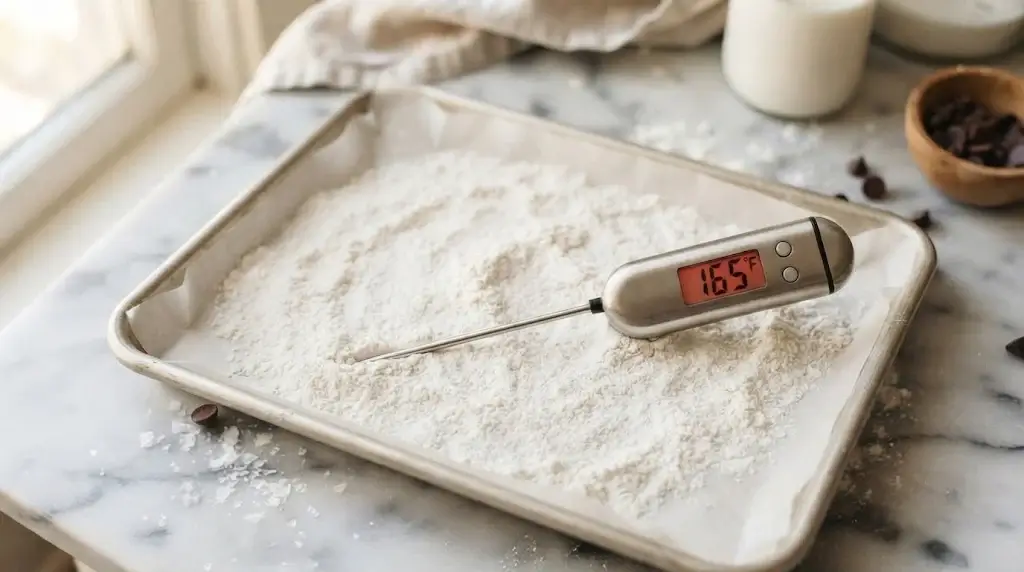
Method 1: Conventional Oven (Best for Even Heating)
- Preheat your oven to 350°F (175°C) and line a rimmed baking sheet with parchment paper.
- Spread 1 cup of all-purpose flour into an even, thin layer across the sheet.
- Bake for 5 to 7 minutes, stirring halfway through to prevent scorching.
- Check with a thermometer to confirm 165°F, then cool completely before mixing with butter.
Method 2: Microwave (Fastest Single-Batch Option)
- Place 1 cup of all-purpose flour in a microwave-safe glass bowl.
- Microwave on high power in 30-second intervals, stirring thoroughly after each burst.
- Repeat for 60 to 90 seconds total until the center registers 165°F on a digital thermometer.
- Sift the cooled flour through a fine-mesh strainer to break up heat-induced clumps.
Pro Tip: Never add hot flour directly to creamed butter. Warm flour melts the butterfat, turning your dough greasy and grainy instead of thick and fluffy.
Step-by-Step Edible Cookie Dough Recipe (Master Base)
This master recipe yields four generous 1/2-cup servings. Gather these exact ingredients before starting:
- 1/2 cup (113g) unsalted butter, softened to room temperature (65°F)
- 1/2 cup (100g) packed light brown sugar for molasses chewiness
- 1/4 cup (50g) granulated white sugar for classic cookie texture
- 1 teaspoon pure vanilla extract
- 1/2 teaspoon fine sea salt to balance sweetness
- 2 to 3 tablespoons whole milk (or heavy cream for extra richness)
- 1 cup (120g) heat-treated all-purpose flour, completely cooled
- 1/2 cup (85g) mini semi-sweet chocolate chips
Instructions
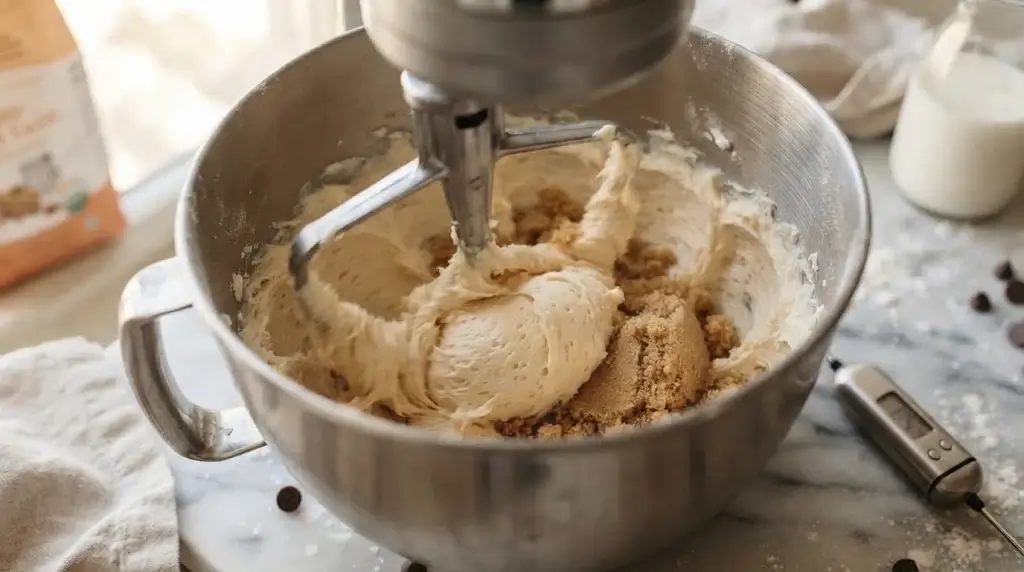
- Cream Butter and Sugars: Beat softened unsalted butter, brown sugar, and granulated sugar in a mixing bowl on medium-high speed for 2 minutes. Stopping only when the mixture turns pale and fluffy ensures the sugar dissolves properly.
- Add Liquids and Salt: Mix in the vanilla extract, fine sea salt, and 2 tablespoons of milk on low speed for 30 seconds until smooth.
- Incorporate Cooled Flour: Add the heat-treated, sifted flour in two additions, mixing on low speed just until no white streaks remain. Add the third tablespoon of milk if the dough feels crumbly.
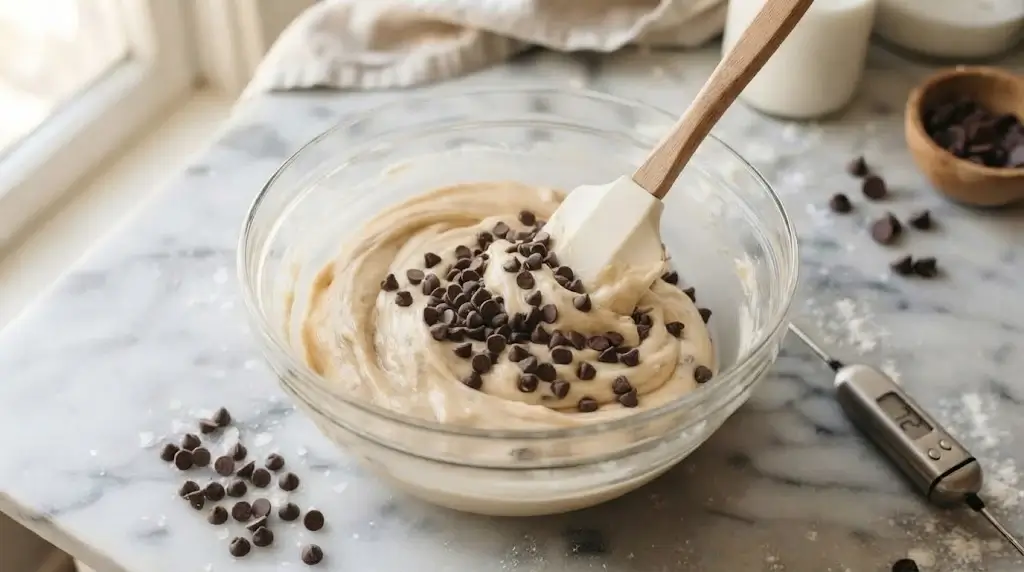
- Fold in Mix-Ins: Use a silicone spatula to fold in mini chocolate chips evenly. Mini chips distribute better per spoonful than standard-sized chips.
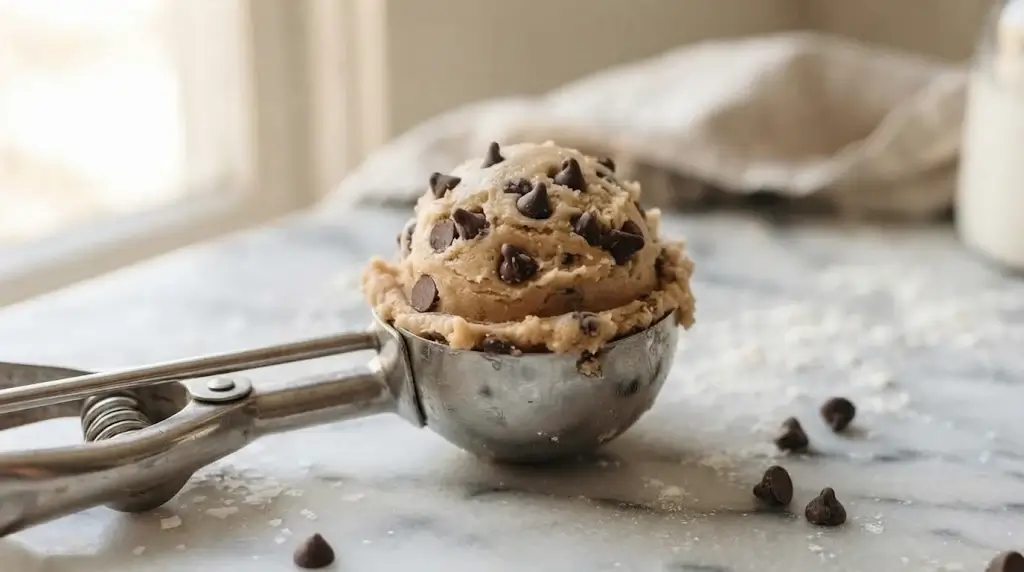
Popular Edible Cookie Dough Variations
Use the master base above and swap mix-ins or dry ratios to build gourmet flavors in seconds.
| Flavor Variation | Base Adjustment | Recommended Mix-Ins |
|---|---|---|
| Classic Chocolate Chip | Standard master recipe | 1/2 cup mini semi-sweet chips + flaky sea salt |
| Double Chocolate Brownie | Replace 1/4 cup flour with unsweetened cocoa powder | 1/3 cup white chocolate chips + 1/4 cup dark chunks |
| Peanut Butter Cup | Add 1/3 cup creamy peanut butter with the butter | 1/2 cup chopped mini peanut butter cups |
| Birthday Cake Batter | Use all white sugar + 1/2 tsp clear imitation vanilla | 3 tablespoons rainbow jimmies (avoid nonpareils) |
| Cookies & Cream | Standard master recipe + 1 tbsp heavy cream | 6 crushed chocolate sandwich cookies |
Common Mistakes & How to Avoid Them
- Grainy, gritty sugar texture: Undercooked or poorly creamed sugar feels sandy on your tongue. Beat the butter and sugars for a full 2 minutes, or pulse brown sugar in a food processor for 15 seconds before mixing.
- Using melted butter instead of softened butter: Melted butter creates an oily puddle that separates in the fridge. Leave butter on the counter for 45 minutes until your finger leaves a gentle indent without sinking through.
- Color bleed in Birthday Cake dough: Tiny round nonpareil sprinkles bleed dye immediately into wet dough. Always fold in waxy rod-shaped rainbow jimmies right before serving.
- Skipping the sifter after heat-treating: Heated flour forms dense micro-lumps that taste chalky. Pass cooled flour through a mesh sieve before adding it to your wet ingredients.
Essential Tools & Resources for Safe No-Bake Dough
Accurate temperature verification and thorough creaming make the difference between gritty dough and bakery-quality results. These reliable tools streamline preparation:
- Instant-Read Thermometer: The ThermoPro TP03 Digital Meat Thermometer (Check Price on Amazon) delivers accurate temperature readings in 3 to 4 seconds so you never underheat or scorch your flour. Its foldaway stainless probe stores compactly in any kitchen drawer. Standout Feature: ±0.9°F accuracy with a backlit LCD screen.
- Stand Mixer: The KitchenAid Artisan Series 5-Quart Tilt-Head Stand Mixer (Check Price on Amazon) whips cold butter and brown sugar into a silky emulsion in two minutes flat. Its flat beater attachment scrapes the bowl efficiently for uniform dough consistency. Standout Feature: 10-speed motor with planetary mixing action.
- Cookie Scoop: The OXO Good Grips Medium Cookie Scoop (Check Price on Amazon) portions uniform 1.5-tablespoon bites ideal for freezing or topping ice cream bowls. Soft, non-slip handles absorb pressure when scooping firm, chilled dough. Standout Feature: Smooth spring-loaded wiper release.
- Baking Sheet: The Nordic Ware Natural Aluminum Commercial Baker’s Half Sheet (Check Price on Amazon) distributes oven heat evenly across thin layers of flour without hot spots. Reinforced steel rims prevent warping under high heat. Standout Feature: Pure rust-proof aluminum construction.
Related Recipes to Try Next
- Delicious Cookie Dough Bites recipes to try
- Why Ben & Jerry’s Chocolate Chip Cookie Dough Ice Cream is Iconic
Food Safety References
Start Mixing Your Safe Batch Today
Learning how to make edible cookie dough takes less time than preheating an oven for baked cookies. By heat-treating your flour to 165°F and skipping raw eggs, you get rich, bakery-style flavor with total peace of mind.
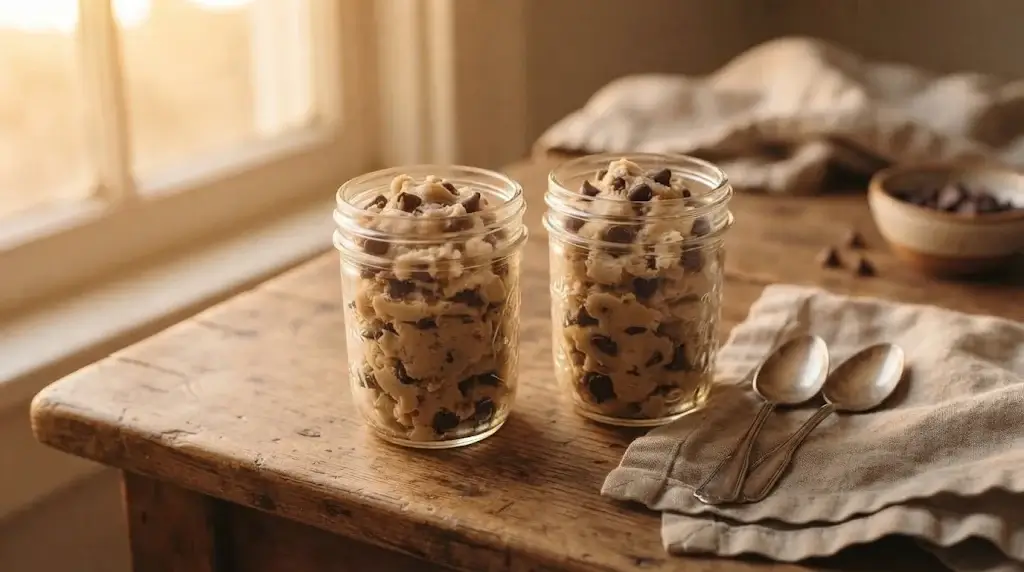
Store leftovers in an airtight glass container in the refrigerator for up to one week. Let chilled dough sit on the counter for 10 minutes before eating so the butter softens back to scoopable perfection.
Frequently Asked Questions
Can you bake edible cookie dough later?
No, edible cookie dough will not bake properly into traditional cookies. Because it lacks eggs for structure and baking soda for lift, baking this dough results in flat, dense, greasy puddles rather than chewy cookies.
Can I use almond flour or oat flour instead of heat-treating?
Yes, blanched almond flour and certified gluten-free oat flour are safe to eat raw without heat-treating because nuts and oats are processed differently than raw wheat. Swap 1 cup of all-purpose flour for 1 1/4 cups of finely ground almond flour.
How long does homemade edible cookie dough last?
Homemade edible cookie dough lasts up to 7 days in the refrigerator when sealed in an airtight container. For longer storage, roll the dough into 1-inch balls and freeze them in a zip-top freezer bag for up to 3 months.
Why does my edible cookie dough taste grainy?
Grainy cookie dough happens when granulated sugar does not dissolve into the butter or when heat-treated flour clumps. Cream the butter and sugars for at least two full minutes, and always sift cooled flour before mixing.