Ultimate Guide to Perfect Chocolate Chip Cookies
Perfect chocolate chip cookies start with a balanced recipe, accurate measurements, and control over dough temperature and baking time. This guide combines a classic Nestlé Toll House recipe with practical guidance from King Arthur Baking on texture, chilling, and troubleshooting. You’ll get measured ingredients, sequential instructions, and a repeatable way to adjust your next batch without guessing.
Table of Contents
- The Art of the Cookie
- Ingredients and Essential Equipment
- Understanding Your Ingredients
- Step-by-Step Baking Instructions
- Professional Baking Tips
- Troubleshooting Texture
- Oatmeal and Chocolate Variations
- Finding Your Favorite Bakery Cookie
The Art of the Cookie
The best chocolate chip cookies are the ones that match your preferred balance of crispness, chew, sweetness, and chocolate. Before baking, decide whether you want a delicate snap, a bendy center, or a softer bite. That target makes recipe choices more useful than any universal claim of “perfect.”
What makes chocolate chip cookies chewy?
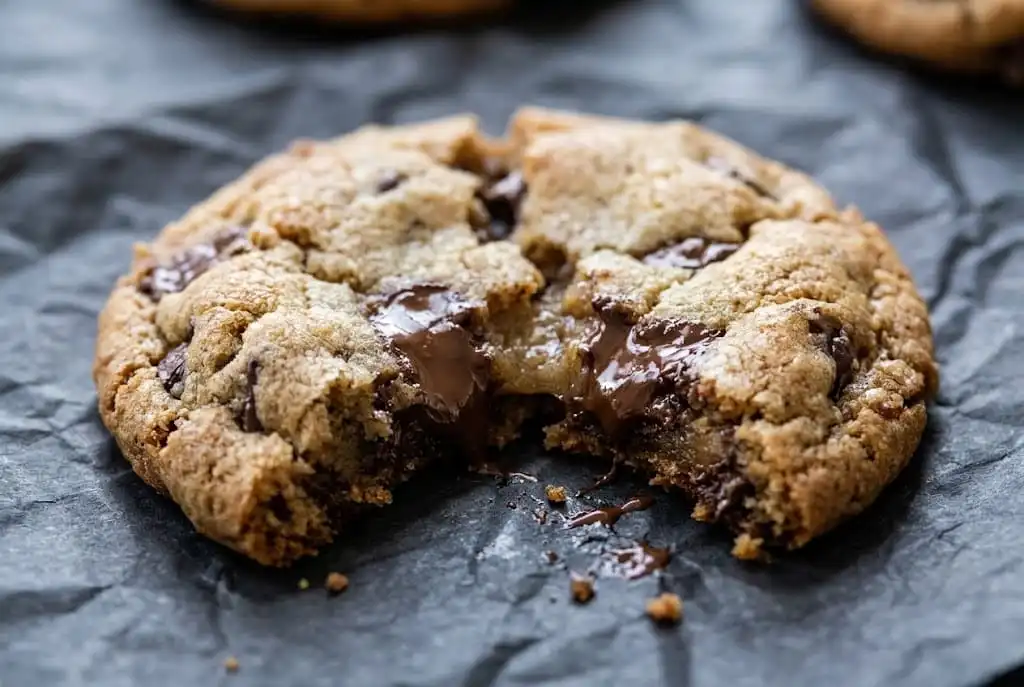
Chewiness depends partly on moisture retention and sugar composition. Brown sugar contains invert sugars that help retain moisture and interfere with sugar recrystallization, while granulated sugar supports a crisper texture. Baking time matters too: longer baking generally produces a firmer finished cookie.
For chewy chocolate cookies with chocolate chips, keep the recipe’s sugar balance intact before experimenting. Cutting sugar is not simply a sweetness adjustment; it also changes spread, browning, and texture.
Flavor and presentation
Build your flavor target around buttery dough, vanilla, chocolate, and balanced salt. For presentation, aim for consistently sized portions and enough space between cookies to preserve their individual shapes. Arrange finished cookies on a plain plate so their golden edges and chocolate pieces remain the focus.
Ingredients and Essential Equipment
This starting recipe follows the classic Nestlé Toll House formula, including its optional nuts. Yield is approximately five dozen small cookies, depending on portion size; bake at 375°F, approximately 190°C. The published baking window is 9–11 minutes per batch.
Exact ingredient list
Use the following quantities. Gram equivalents are rounded conversions; teaspoons remain more practical for small amounts.
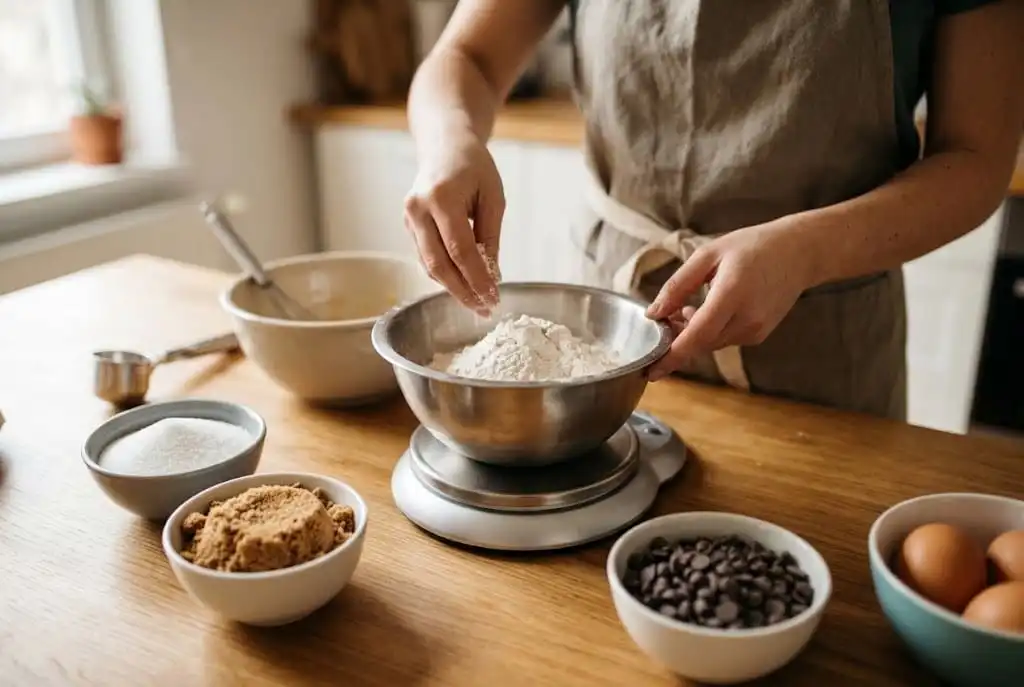
- All-purpose flour: 270 g, or 2¼ cups.
- Baking soda: approximately 6 g, or 1 teaspoon.
- Fine table salt: approximately 6 g, or 1 teaspoon.
- Unsalted butter, softened: 227 g, or 1 cup / 2 sticks.
- Granulated sugar: 149 g, or ¾ cup.
- Packed light brown sugar: 160 g, or ¾ cup.
- Vanilla extract: approximately 4 g, or 1 teaspoon.
- Large eggs: 2, approximately 100 g without shells.
- Semisweet chocolate chips: 340 g, or 2 cups.
- Chopped walnuts: approximately 113 g, or 1 cup, optional.
For cookies without nuts, omit the walnuts and add 15 g flour, or 2 tablespoons, bringing the total flour to 285 g. This follows Nestlé’s instruction to add extra flour when omitting nuts.
Tools that support consistency
Gather a digital kitchen scale, mixing bowls, a rubber spatula, an electric hand mixer or stand mixer with a paddle attachment, and cooling racks. Use a tablespoon-sized cookie scoop for repeatable portions and sturdy, heavy-duty baking sheets lined with parchment or silicone baking mats. Keep the same pan and liner combination throughout your first batch, because baking surfaces influence spread.
Understanding Your Ingredients
Substitutions work best when you understand what you are changing. Make the original version first, then alter one ingredient at a time so the result teaches you something useful.
| Ingredient | Why it matters | Best Alternative |
|---|---|---|
| All-purpose flour | Establishes the dough’s structure and balance | Keep it for the baseline; use a dedicated recipe for other flours |
| Unsalted butter | Supplies fat and lets you control added salt | Salted butter, with a salt adjustment |
| Light brown sugar | Helps retain moisture for a bendier texture | Dark brown sugar |
| Granulated sugar | Contributes sweetness, spread, and crispness | Keep unchanged for predictable results |
| Semisweet chips | Provide the recipe’s chocolate component | Chopped chocolate in an appropriate cookie recipe |
| Large eggs | Supply the specified amount of egg for this formula | Use large eggs rather than estimating another size |
Brown sugar options and sugar functions are supported by King Arthur’s cookie testing; its recipe standards also emphasize specified ingredients and egg size.
If using salted butter, reduce the added salt by ½ teaspoon for this batch, leaving ½ teaspoon. Avoid substituting coarse salt spoon-for-spoon: different crystal sizes measure differently by volume.
How do you bake chocolate chip cookies consistently?
Bake consistently by measuring carefully, following the same mixing sequence, portioning evenly, and observing your first tray before committing the remaining dough. Use the recipe’s time as a checking window rather than treating the timer as the only evidence. Nestlé specifies golden-brown cookies, followed by a short rest on the sheet.
Step-by-step baking instructions
- Prepare your workspace. Measure every ingredient before mixing. Set out your bowls, mixer, scoop, spatula, sheets, and cooling racks so you can follow the sequence without interruptions.
- Prepare the oven and pans. Preheat to 375°F / 190°C. Line your baking sheets with parchment or silicone mats; do not add an extra coating of grease.
- Combine the dry ingredients. Whisk the flour, baking soda, and salt together in a separate bowl. Include the additional flour here if you are making the version without nuts.
- Cream the butter mixture. Beat softened butter, both sugars, and vanilla until creamy. Scrape the bowl so ingredients collecting around the sides rejoin the mixture.
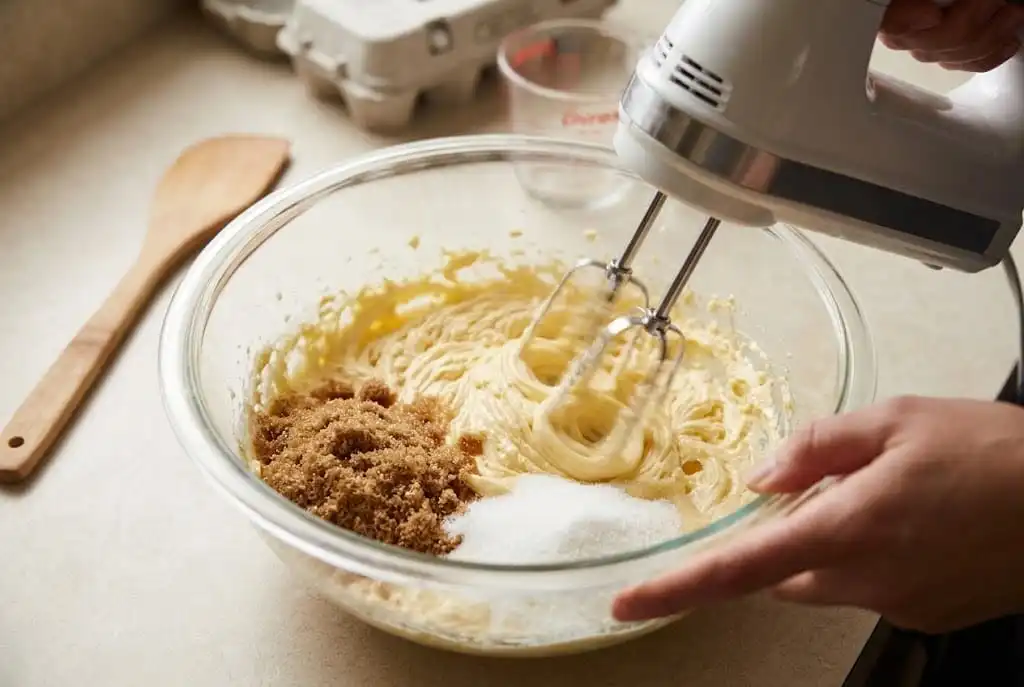
- Add the eggs individually. Beat in one egg, then the second, mixing well after each addition. Scrape the bowl again before adding the flour.
- Complete the dough. Gradually incorporate the flour mixture. Stir in the chocolate chips and, if using, the chopped walnuts.
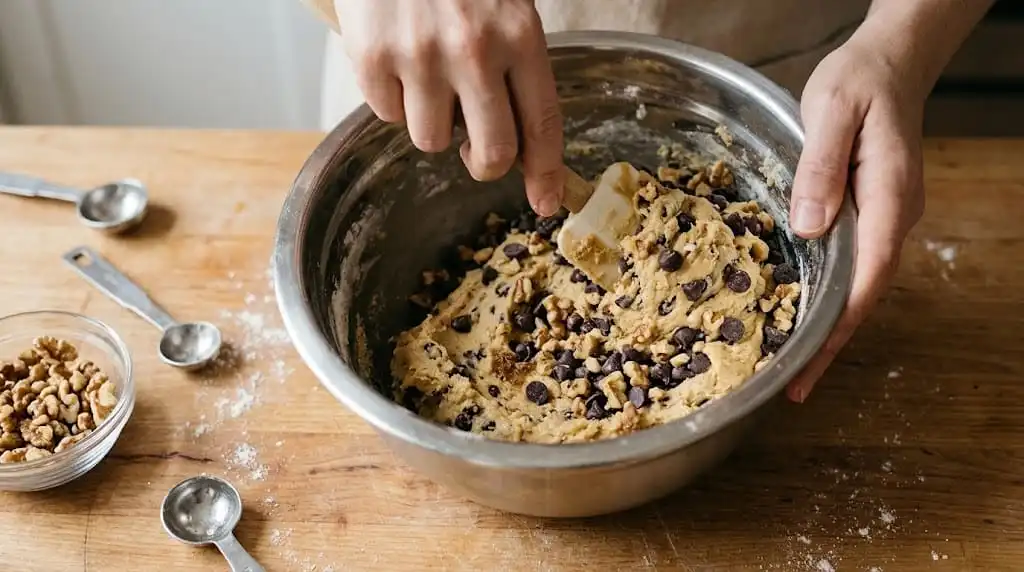
- Chill for better control. Cover and refrigerate the dough for approximately 30 minutes before scooping. Chilling firms the fat and can reduce spread; longer resting also changes flavor and texture.
- Portion a test tray. Scoop rounded tablespoon portions onto the prepared sheet, leaving room for spreading. Record the scoop size so later trays remain comparable.
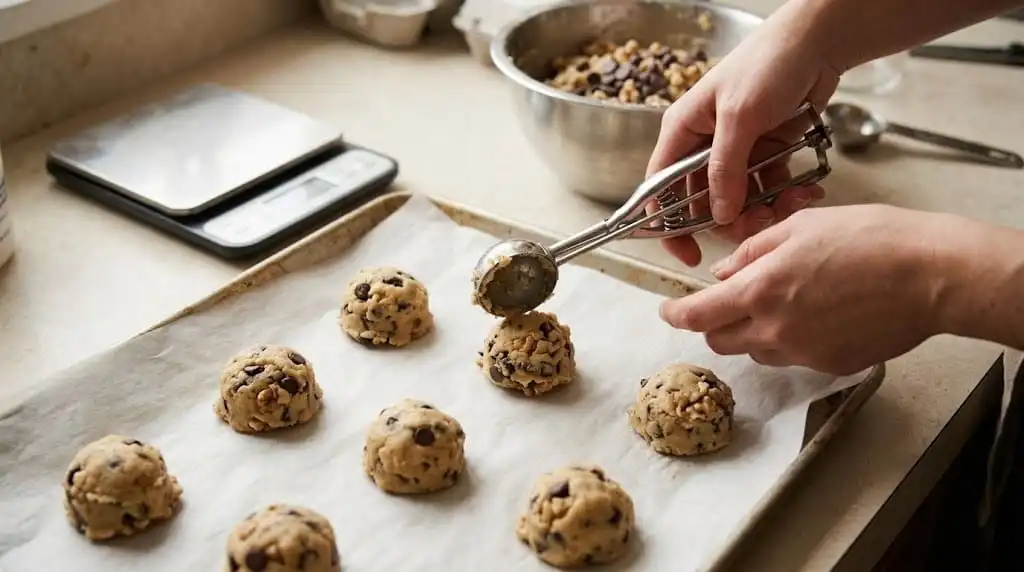
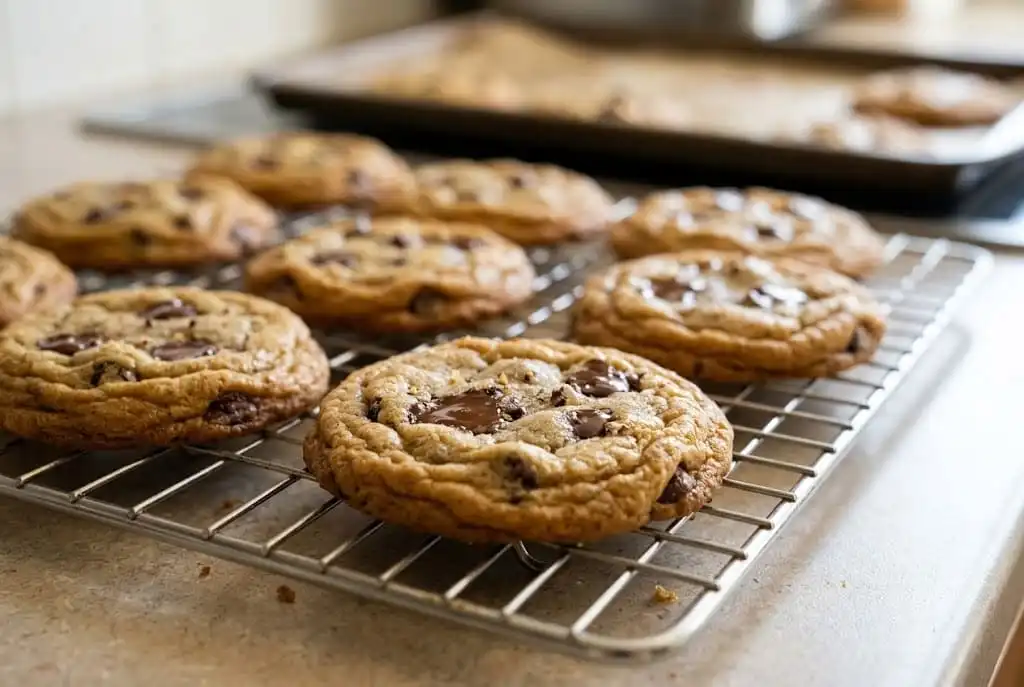
- Bake and cool. Check within the 9–11-minute window and bake until golden brown. Rest cookies on the sheet for 2 minutes, then transfer them carefully to a rack to finish cooling.
Taste your test cookie after cooling before making adjustments. Note its edge texture, center texture, and overall thickness; those observations give you a more useful baseline than a quick judgment while the chocolate is still hot.
Professional Baking Tips
Verify oven temperature
Use an independent oven thermometer to confirm that the oven is fully preheated. If cookies brown unevenly, rotate the sheet front to back partway through baking. King Arthur recommends both practices to address unreliable preheating indicators and oven hot spots.
Keep a brief baking log: temperature setting, measured temperature, portion size, chilling time, and final baking time. Change only one variable in your next trial. This turns an imperfect tray into useful information rather than a reason to abandon the recipe.
Give chilling a clear purpose
Chilling is more than a scheduling convenience. Firmer fat takes longer to melt, while resting changes how the dough behaves and how the finished cookie tastes. Even a short chill can make a noticeable difference; an overnight rest is a useful comparison for a later batch.
For a simple experiment, split one dough batch into two labeled containers. Bake one after the short chill and the other the following day, keeping portions and pans consistent. Compare the cooled results before deciding which version you prefer.
Protect the finished texture
Let cookies cool before sealing them in an airtight container. Store soft cookies separately from crisp ones, and choose a properly sealed container rather than an open cookie jar when softness is the goal.
For future baking, freeze individual dough portions on a sheet, then transfer them to an airtight freezer container. Bake the portions from frozen, allowing for a possible extra minute or two and checking the result rather than automatically extending every batch.
Why did my cookies turn out differently?
Different results usually point to a change in measurement, mixing, temperature, or baking surface—not a mysterious failure. Flat cookies, for example, can result from too little flour, insufficient chilling, over-creaming, or an oven that is too cool. Check those variables before adding ingredients to the remaining dough.
Use this troubleshooting order:
- Confirm measurements. Review the flour weight and make sure the brown sugar was packed if measured by cups.
- Check temperature. Verify the oven reading and whether you chilled the dough as planned.
- Review mixing. Compare your method with the recipe rather than assuming more beating is always better.
- Inspect the setup. Note any change in pan, liner, portion size, or baking position.
- Run another small test. Adjust one variable and record the outcome.
Keep food safety separate from texture preferences. Do not taste raw dough: both untreated flour and raw eggs can contain harmful germs. Wash hands, bowls, tools, and work surfaces after handling them.
Oatmeal and Chocolate Variations
For the best oatmeal chocolate chip cookies for your taste, start with a recipe designed around oats rather than adding an arbitrary handful to this dough. King Arthur’s oatmeal version uses both flour and rolled oats, along with a different egg and leavener balance. That complete formula offers a more reliable starting point than an improvised substitution.
For a softer wheat-based variation, consider a dedicated soft chocolate chip cookie recipe. King Arthur’s version permits chocolate chips or chopped chocolate, making it a useful route for exploring different chocolate formats without simultaneously redesigning the dough.
Save browned butter for a separate experiment. Browning removes water, so replacing all the softened butter with browned butter can produce a different dough; King Arthur discusses browning only part of the butter as a more controlled approach.
Finding Your Favorite Bakery Cookie
Searching for “best chocolate chip cookies near me” can help you identify styles worth comparing, even when you enjoy baking at home. Choose candidates by your preferences rather than treating one rating as a universal verdict.
When sampling, consider:
- Texture: Do you prefer thin and crisp, thick and soft, or distinctly chewy?
- Chocolate balance: Does the chocolate complement the dough or dominate it?
- Serving condition: Ask whether the cookie is served warm or at room temperature.
- Value to you: Compare portion size, price, and how much you enjoy the whole cookie.
Use that tasting as inspiration for your next baking goal—not as pressure to copy a bakery perfectly.
Bake a test tray, take notes, and make the next batch your own. Share a photo of your results and leave a star rating or comment describing your favorite texture. If clearly labeled affiliate links accompany this guide, explore the recommended scale, scoop, baking sheets, and oven thermometer before choosing tools that suit your kitchen.