The Ultimate Oreo Inspired Crumbl Cookies: The Definitive Bakery-Style Guide
Quick Answer: How to Make Oreo Inspired Crumbl Cookies
An authentic Oreo inspired Crumbl cookie requires heavily alkalized black cocoa powder, chilled high-fat European butter, and a specific 5.5-ounce dough portioning technique. Combining black cocoa with finely crushed real Oreo wafers replicates the exact bitter-sweet, dark chocolate crumb signature to the commercial bakery.
The dense, ultra-thick texture relies on minimal creaming time, cold-dough resting, and a high-heat, short bake cycle that leaves the center fudgy. Top each cooled cookie with a thick spiral of chilled, tangy cream cheese frosting and fine cookie crumb dust.
- Base Flour-to-Cocoa Ratio: 4:1 all-purpose flour to black cocoa powder for deep color without astringency.
- Portion Weight: 156 grams (5.5 oz) per cookie dough ball to ensure an underbaked, soft center.
- Bake Time: 10 to 11 minutes at 350°F (177°C) on a heavy aluminum sheet pan.
- Frosting Profile: 2:1 powdered sugar to block cream cheese emulsified with pure vanilla bean paste.
Introduction: The Cult of the Giant Cookie
Crumbl Cookies reshaped commercial baking through massive portions, rotating menus, and signature soft centers. Among their rotating portfolio, their Oreo-themed releases consistently drive high customer demand and viral social media trends.
This guide serves dessert enthusiasts, home bakers, and Crumbl fans who want bakery-level precision in their home kitchen. Recreating this cookie does not require proprietary commercial emulsifiers or industrial planetary mixers.
You will learn the fundamental food science behind black cocoa, proper dough hydration, and emulsified cream cheese frosting. Mastering these variables allows you to bake dense, bakery-grade cookies that surpass the original in flavor and texture.
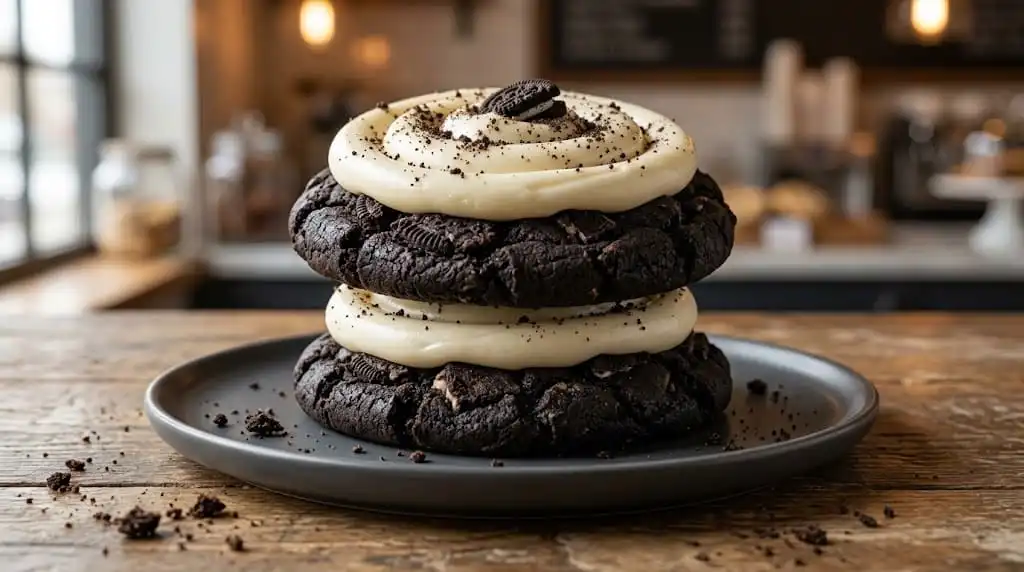
The Anatomy of a Crumbl-Style Cookie
A standard drop cookie relies on caramelization, thin edges, and significant spread. Crumbl cookies break standard baking conventions by functioning more like miniature individual cakes with a dense, fudgy crumb structure.
Weight and Thickness Metrics
A standard homemade chocolate chip cookie weighs roughly 35 to 45 grams. In contrast, an authentic Oreo inspired Crumbl cookie dough ball weighs between 150 and 160 grams (approximately 5.5 ounces).
This immense volume protects the center from heat penetration during the short baking window. The outer shell forms a delicate crumb boundary, while the interior retains a soft, brownie-like texture.
Crumb Density vs. Cakeyness
Many failed copycat recipes yield light, airy, cake-like cookies. This problem stems from over-aerating the butter and sugar during the initial mixing stage.
To produce the trademark Crumbl density, cream the butter and sugar only until combined, without whipping excessive air into the fat matrix. Low aeration paired with cornstarch suppresses gluten development and keeps the crumb compact.
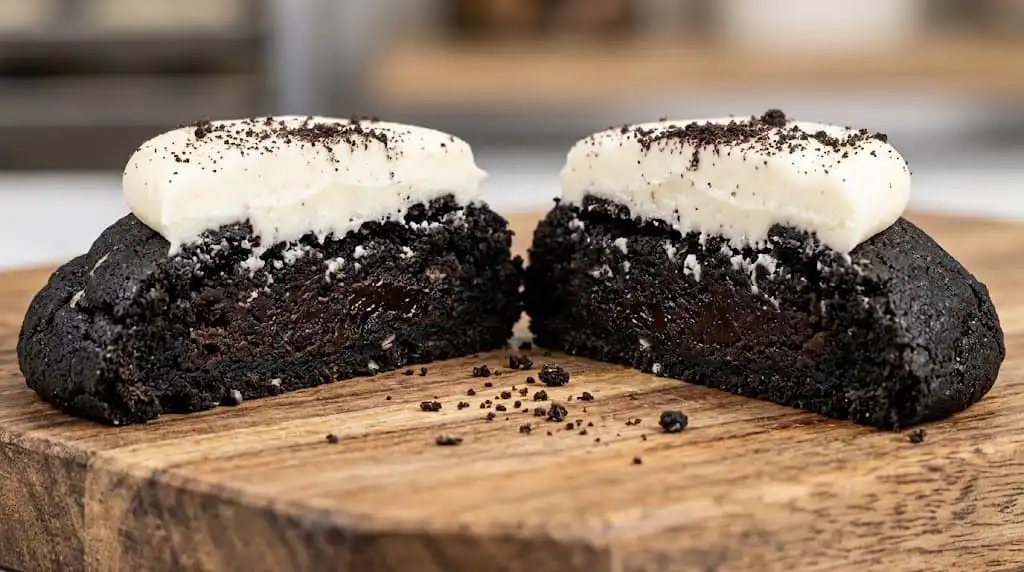
Cocoa Science: Achieving the Authentic Black Oreo Base
The defining characteristic of an Oreo cookie is its jet-black appearance and unique chocolate profile. You cannot achieve this color or flavor using standard natural cocoa powder from the grocery store.
Natural vs. Dutch-Process vs. Black Cocoa Powder
Natural cocoa powder is acidic, with a pH ranging between 5.0 and 5.8. It exhibits a lighter brown color and sharp, fruity notes that clash with the classic sandwich cookie flavor profile.
Dutch-process cocoa undergoes an alkalizing wash that neutralizes the acid, elevating the pH to around 7.0. This yields a mellow, darker powder that performs well in cakes and brownies.
Black cocoa powder represents the extreme end of the Dutch process, treated with potassium carbonate solution until the pH reaches 8.0 or higher. This heavy alkalization strips away acidity, yielding an earthy, roasty flavor and charcoal-black pigment.
- Natural Cocoa (pH 5.2): Light tan color; acidic bite; excessive spread in cookies; incorrect for Oreo profile.
- Dutch-Process Cocoa (pH 7.0): Rich mahogany; smooth flavor; acceptable substitute if blended with black cocoa.
- Black Cocoa (pH 8.2+): Jet black; distinct Nabisco-style roasted aroma; zero acidity; mandatory for true copycats.
Why Leavening Agents Matter with Black Cocoa
Because black cocoa contains almost no active acid, it cannot react with baking soda (sodium bicarbonate) to create carbon dioxide gas. If you use only baking soda, the dough will lack lift and can turn soapy.
This recipe uses baking powder as the primary leavener because it contains its own built-in acid. A minor pinch of baking soda is retained strictly to assist with Maillard browning and edge setting.
Key Ingredients and Formulation Logic
Every component in this recipe balances moisture retention against structural integrity. Professional bakers evaluate ingredients by functional role rather than simple volume.
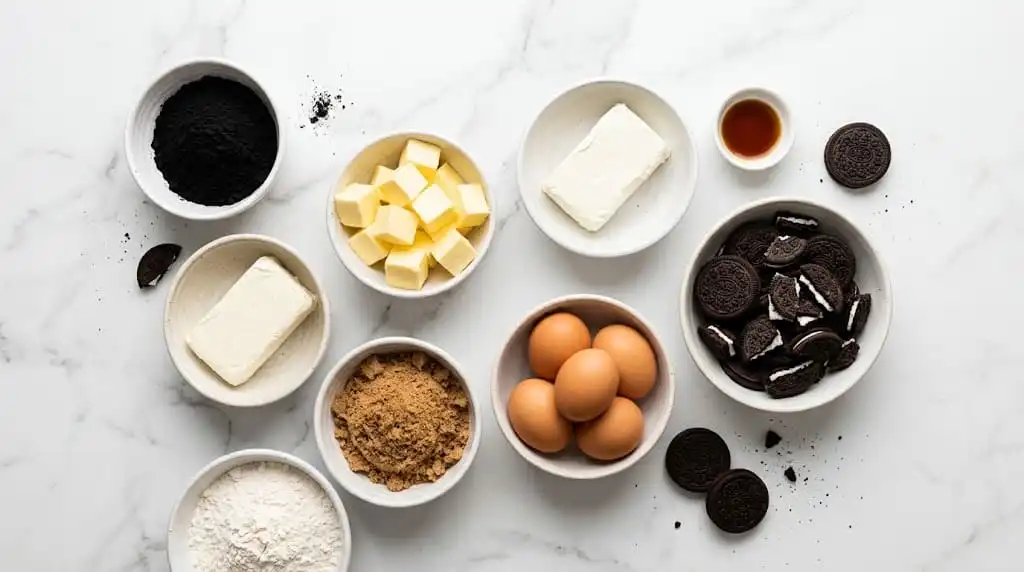
Fat Systems: High-Fat European Butter
Standard American butter contains approximately 80% butterfat and 16% to 18% water. The high moisture content in standard butter generates steam in the oven, encouraging gluten development and unwanted spread.
European-style butter contains 82% to 84% butterfat. The lower water ratio creates a shorter, tender crumb and provides superior rich mouthfeel that matches commercial bakeries.
Sugar Architecture: White vs. Light Brown Sugar
Granulated white sugar promotes spread and surface crispness. Brown sugar contains molasses, which is hygroscopic and binds free water in the dough.
We use a 60/40 ratio favoring light brown sugar over granulated white sugar. This combination ensures chewy interior moisture while retaining sufficient structure on the cookie perimeter.
The Real Oreo Inclusions
Do not substitute generic chocolate sandwich cookies. The cream filling and wafer formulation of brand-name Oreos possess specific melting points and fat profiles that affect dough consistency.
Crush the cookies into two distinct sizes. Pulverize half into a fine dust that integrates into the flour matrix, and chop the remaining half into coarse chunks for textural contrast.
| Ingredient | Metric (Grams) | US Volume | Functional Role |
|---|---|---|---|
| Unsalted European Butter (Cold, Cubed) | 226 g | 1 cup (2 sticks) | Tenderizes crumb, controls spread, adds richness. |
| Light Brown Sugar (Packed) | 165 g | 3/4 cup | Moisture retention, chewiness, subtle caramel notes. |
| Granulated White Sugar | 100 g | 1/2 cup | Edge structure, crisp exterior crust. |
| Large Eggs (Cold) | 100 g | 2 whole eggs | Emulsification, structure, protein binding. |
| Pure Vanilla Extract | 10 g | 2 tsp | Aromatics, rounds out roasted cocoa bitterness. |
| All-Purpose Flour (11.7% protein) | 340 g | 2 3/4 cups | Main structure; prevents excessive spreading. |
| Black Cocoa Powder | 65 g | 3/4 cup | Deep black pigment, signature Oreo flavor. |
| Cornstarch | 12 g | 1 tbsp | Weakens gluten; yields ultra-soft center. |
| Baking Powder | 6 g | 1 1/2 tsp | Vertical rise in non-acidic black cocoa environment. |
| Fine Sea Salt | 4 g | 3/4 tsp | Balances sweetness, enhances cocoa depth. |
| Oreo Cookies (Roughly Chopped) | 140 g | 1 1/4 cups (approx. 12 cookies) | Textural chunk inclusion, iconic flavor accent. |
Step-by-Step Master Baking Guide
Precision execution guarantees consistent results. Follow these instructions in chronological sequence to avoid structural collapse or tough texture.
Step 1: Prep and Dry Component Homogenization
What: Whisk the dry ingredients together in a large bowl.
Why: Black cocoa powder is prone to clumping due to its dense, oil-stripped nature. Sifting ensures uniform distribution so individual bites do not taste chalky.
How: Place all-purpose flour, black cocoa, cornstarch, baking powder, and salt through a fine-mesh sieve. Whisk vigorously for 45 seconds until the mixture is uniform dark gray.
Pro Tip: Do not add chopped Oreos to this bowl yet. The cookies will break down prematurely during the sifting process.
Step 2: Low-Aeration Creaming
What: Combine cold cubed butter and sugars in a stand mixer fitted with the paddle attachment.
Why: Traditional recipes demand creaming until light and fluffy. Doing that here incorporates micro-air pockets that cause giant cookies to rise like balloons and then collapse into flat, wrinkled discs.
How: Mix on low speed (Speed 2 on a KitchenAid) for 90 to 120 seconds. The mixture should form a thick, cohesive paste where the sugars are incorporated, but no pale volume has developed.
Common Mistake: Using room-temperature melted butter. Soft butter causes excessive dough spreading in the oven.
Step 3: Egg and Vanilla Emulsification
What: Incorporate the cold eggs and pure vanilla extract.
Why: Eggs provide the sole liquid hydration in this dough. Cold eggs prevent the cold butter matrix from warming up during mixing.
How: Add the eggs one at a time with the mixer running on low. Mix each egg for precisely 20 seconds before adding the next, finishing with the vanilla.
Pro Tip: Scrape down the bowl sides and the bottom paddle thoroughly with a silicone spatula to prevent unmixed pockets of butter fat.
Step 4: Dry Integration and Inclusions
What: Combine the dry flour blend and chopped Oreos into the wet emulsion.
Why: Excessive agitation once flour contacts liquid activates gluten proteins, resulting in a rubbery, tough cookie.
How: Dump all dry ingredients into the bowl at once. Pulse the mixer 4 to 6 times until the flour is 80% absorbed. Add the chopped Oreos and run on low speed for 10 seconds to finish folding.
Common Mistake: Overmixing until the dough looks glossy. The dough should look shaggy, heavy, and matte black.
Step 5: Precision Portioning and Shaping
What: Scale and shape the dough into 5.5-ounce portions.
Why: Uniform weight guarantees that every cookie bakes at the exact same rate. Uneven sizing causes smaller cookies to dry out while larger ones remain raw.
How: Use a digital kitchen scale to measure portions to 156 grams each. Roll the dough into tall, rough cylinders rather than smooth spheres, keeping the top surface textured.
Pro Tip: A jagged, rough top creates the rustic bakery aesthetic that traps the frosting later.
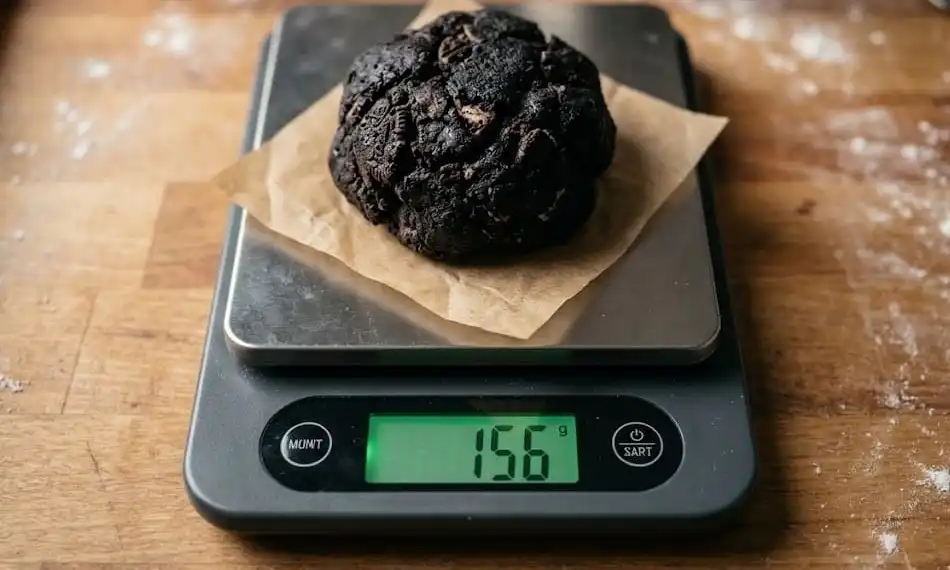
Step 6: The Mandatory Chill Period
What: Chill the portioned dough cylinders in the refrigerator.
Why: Chilling solidifies the butterfat, completely hydrates the flour starches, and concentrates cocoa flavors. Baking room-temperature dough guarantees flat, greasy cookies.
How: Place shaped cylinders on a parchment-lined tray, cover loosely with plastic wrap, and refrigerate for a minimum of 2 hours, preferably 4 hours.
Pro Tip: If short on time, freeze the dough balls for 45 minutes to rapidly chill the butter core.
Step 7: The High-Heat Flash Bake
What: Bake the chilled dough on a preheated heavy aluminum sheet.
Why: High heat sets the outer crust immediately, freezing the cookie’s height before the core fat melts completely.
How: Preheat oven to 350°F (177°C). Space only 4 to 5 cookies per standard half-sheet pan to allow adequate air circulation. Bake for 10 to 11 minutes.
Warning: The edges will look matte and firm, but the centers will appear soft and slightly wet. Do not keep baking; carryover heat finishes the core on the tray.
Step 8: The Circular Pan-Banging Method
What: Swirl a large round cookie cutter or bowl over each hot cookie immediately upon removal from the oven.
Why: High-heat baking can cause slight asymmetry. Swirling pulls the warm edges inward, compacting the outer perimeter into a perfect commercial circle.
How: Place a 4.5-inch round cutter over the cookie while it rests on the hot sheet. Gently rotate the cutter in a circular motion for 5 seconds per cookie.
Pro Tip: Allow cookies to cool on the baking sheet undisturbed for 20 minutes before moving to a wire rack.
Mastering the Signature Cream Cheese Frosting
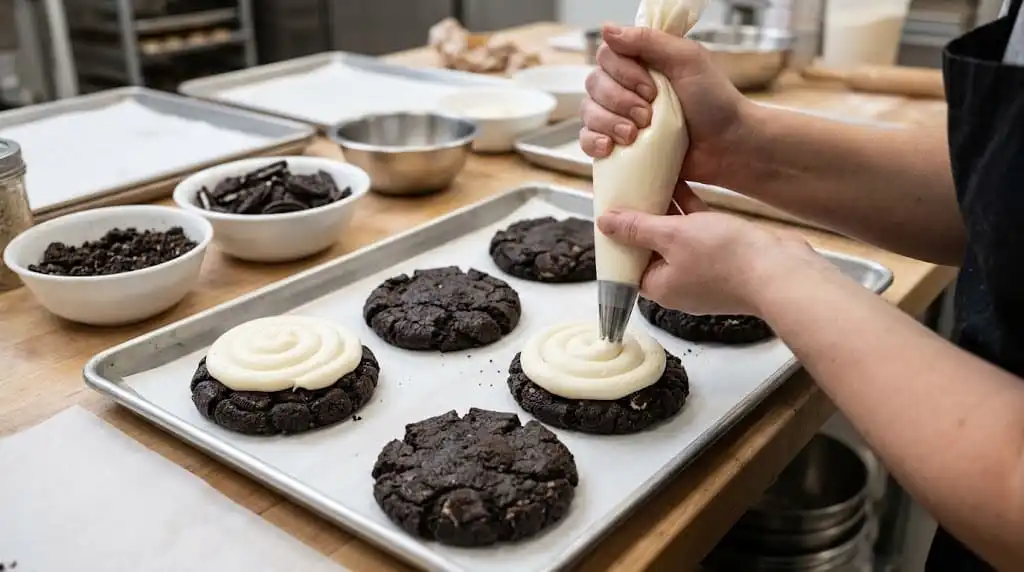
The dark chocolate base is intentionally deep, earthy, and mildly sweet. It requires a bright, tangy counterpoint, which Crumbl achieves using their signature dense cream cheese frosting.
Bakery-Style Vanilla Cream Cheese Frosting Formula
- Full-Fat Block Cream Cheese (Slightly Chilled): 226 g (8 oz / 1 block)
- Unsalted Butter (Room Temperature): 113 g (1/2 cup / 1 stick)
- Powdered Sugar (Sifted): 360 g (3 cups)
- Pure Vanilla Bean Paste: 5 g (1 tsp)
- Fine Table Salt: 1 g (pinch)
Emulsification Technique:
Beat the butter and cream cheese together using a paddle attachment on medium-high speed for 3 minutes until smooth and lump-free. Add the sifted powdered sugar in two additions on low speed, then add the vanilla bean paste and salt.
Once combined, switch to low speed for 60 seconds to push out large air bubbles. This creates a dense, velvety consistency suitable for piping clean spirals.